

Business strategy frameworks answer different questions, so the first decision is what you need to learn: the outside environment, the competitive position, the business model or the execution plan. A small company can begin with SWOT plus one outside-in tool.
The sections below set out the criteria for choosing, then walk through each framework by use case and company size. Readers who want the mechanics of the most familiar tool can open a guide that answers what is swot analysis and return here to place it among the alternatives.
Choosing a strategy framework: the criteria that matter
A framework is a structured way to ask a set of questions. Picking one therefore starts with the question you cannot yet answer, not with the tool that sounds most rigorous. A directory of strategy frameworks at B2B Frameworks describes the field as covering every aspect of business strategy, from marketing and growth to brand and innovation. That breadth is the reason a single favourite tool rarely fits every decision.
Start with the question you need answered
- “What is happening around us?” Choose an outside-in tool: PESTEL for broad forces that shape a business, Porter’s Five Forces for competitive intensity in an industry.
- “What do we have, and what are we missing?” SWOT sits here, because it combines an honest look inside the business with the opportunities and threats outside it.
- “How does the business actually work?” The business model canvas looks at a company as a whole, which suits a new venture or a model under review.
- “Where could we do something different?” Blue ocean strategy is positioned in the same directory as a way to kick-start innovation.
- “How do we make the plan happen?” OKRs and the balanced scorecard belong to execution and measurement, not to the original analysis.
Match the tool to company size and capacity
Capacity is the quiet criterion. A framework that needs data from many departments, regular scoring and a dedicated owner can swamp a team where the founder also handles sales. Light tools suit small companies: a SWOT can be drawn on a whiteboard in one sitting, and a business model canvas fits on a single printed sheet. Larger organisations gain more from tools that coordinate many teams, such as a balanced scorecard or a strategy map, because their main risk is units pulling in different directions.
The practical rule is to choose the lightest tool that answers the question, and add a heavier one only when the lighter result leaves a gap. A small team that skips this step often ends up with a polished analysis and no time left to act on it.
Allow for stable versus uncertain conditions
Most analysis frameworks assume that causes and effects can be studied and then planned for. When conditions are unclear or shifting quickly, a tool that sorts the type of situation helps before any detailed analysis begins. The cynefin framework is built for that sorting step. It does not replace SWOT or Five Forces; it tells you how much planning a given problem can bear.
What a business strategy includes
A business strategy is a set of choices about where a company will compete, how it intends to win there and what resources it will commit. Frameworks do not make those choices. They organise the evidence so the choices are made deliberately rather than by habit.
Strategy: the choices and how they are carried out
A complete strategy has a direction and a method for delivering it. Direction is the purpose and aspiration of the company, which is where a short guide to vision vs mission statement helps, because the two are often confused. Method is the analysis, the choice of position and the plan for execution. One consultancy, writing at TKD Consult, defines a strategy execution framework as a systematic set of phases, mechanisms and governance structures. It describes four elements that feed each other in a continuous cycle: Plan, Align and Mobilize, Execute, and Review and Adapt.
That cycle is a useful test of completeness. A document that only analyses the market covers the Plan element and leaves the other elements to chance.
Business model: how the company works as a whole
Strategy and business model overlap but answer different questions. The business model describes how the company creates and delivers value in its current form. Strategy describes the choices that shape or change that model against competitors. The business model canvas is recommended by B2B Frameworks for looking at a company as a whole, which is why it is the natural tool when the question is about the model rather than the market. A company can have a clear model and no strategy: it knows how it operates but has not decided how it will outperform rivals.
Competitive advantage as the test
Competitive advantage is the outcome a strategy is trying to produce, and it depends on the industry as much as on the firm. According to the investment manager Harding Loevner, an industry with a high barrier to entry gives an incumbent a stronger competitive advantage. A firm’s advantage is therefore partly something it builds and partly something its industry structure allows. Frameworks that look only inward miss the second half.
Reading the environment: SWOT, PESTEL and Five Forces
These three tools are the usual starting point because they ask what is true before anyone decides what to do. They differ in scope, and the difference decides the order in which a small team should use them.
SWOT analysis: strengths, weaknesses, opportunities and threats
SWOT sorts observations into internal factors (strengths and weaknesses) and external factors (opportunities and threats). Harding Loevner notes that methods such as SWOT provide unique and valuable insights into a business, whereas Five Forces looks at the industry. SWOT is therefore best read as a snapshot of one company in its context.

A typical run goes in a simple order. List internal strengths and weaknesses, list external opportunities and threats, then cross-check each entry for evidence so that wishes and worries do not pass as facts. The weak point of SWOT is vagueness. A list of generic items such as “good team” gives nothing to act on, so each entry should name a customer, a competitor or a capability. When the lists are done, the tows matrix turns them into actions by pairing internal factors with external ones.
SWOT suits companies of every size, and it is the best first tool for a small business with limited time. For a gentle introduction, see the guide that answers what is swot analysis? The point of difference between this link and the one in the opening is purely navigational; both lead to the same walkthrough.
PESTEL analysis: the forces that shape a business
PESTEL stands for political, economic, social, technological, environmental and legal factors. B2B Frameworks lists PEST, its shorter ancestor, as a framework to assess the forces that shape a business. The tool is deliberately broad, so it fits best when a company is entering a new market, facing regulation or weighing a long-term investment.
Its main risk is length without judgement. A long catalogue of external trends is easy to produce and hard to use. The discipline that makes PESTEL worthwhile is to keep only the factors that could change demand, cost or the rules of the market for this particular company, and to say which way each one pushes. A guide that explains what is pestel analysis goes through each letter in detail.

Small companies can run PESTEL lightly, as a one-page scan before a major decision. Larger firms tend to treat it as a recurring input to planning, since their exposure to economic and regulatory change is wider.
Porter’s Five Forces: industry structure and rivalry
Harding Loevner reports that the framework was first introduced in a 1979 issue of Harvard Business Review and later detailed in a 1980 book by Michael Porter. It identifies competitive dynamics through five forces: buyers, suppliers, substitutes, new entrants and rivalry. The same source stresses that the analysis looks beyond the company into its industry, and that no single force determines the health of an industry. Only by analysing all five does the picture hold. The B2B Frameworks directory sums up its purpose as assessing competitive intensity. The full method is covered in the guide to porter’s five forces.
The steps are straightforward. Take each force in turn and ask a specific question. For new entrants, Harding Loevner suggests asking how likely a newcomer is to enter the industry. Then judge whether each force is strong or weak for the company. Two conclusions follow from the source. First, a high barrier to entry strengthens an incumbent’s competitive advantage. Second, the more rivalry within an industry, the harder it is to achieve profitable growth. A reader choosing between markets can use those two statements as screening rules.

Five Forces rewards patience but not heavy data work. A small company can use it before choosing a niche, by asking which of the forces would squeeze margins in each candidate market. Because it looks outward, it complements SWOT rather than competing with it.
Designing the business model and the offer
Once the environment is understood, the next question is what to offer and how the business will deliver it. The tools in this group are creative rather than diagnostic, and they suit early-stage ventures and companies rethinking their model.
Business model canvas
The canvas lays the model out on a single sheet, so a team can see customers, value, channels, revenue and costs side by side. B2B Frameworks recommends it to look at a company as a whole. Its strength is speed: a founding team can sketch a model, challenge the weakest box and redraw, all in one working session. The guide on what is the business model canvas covers the layout of the sheet.
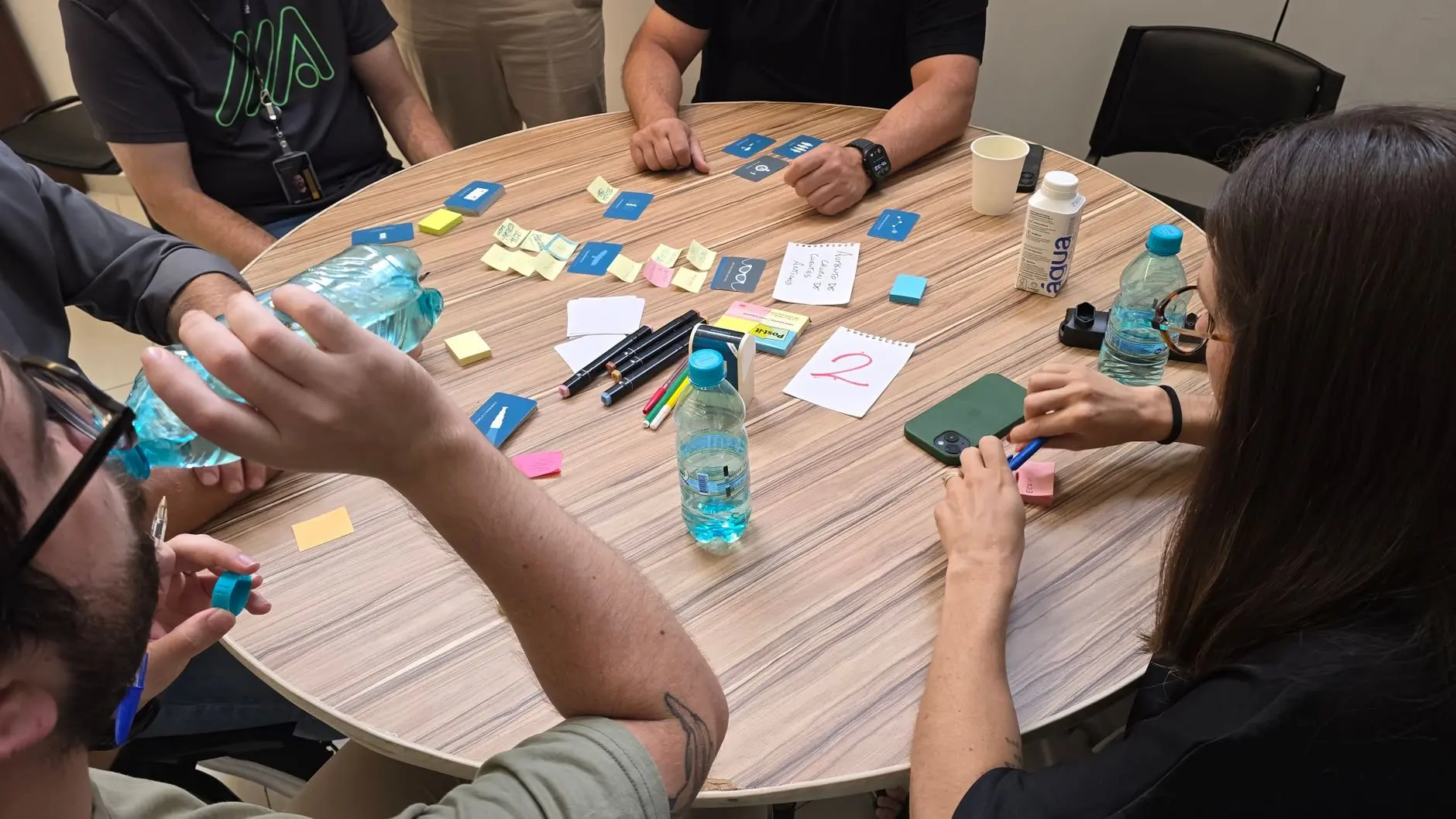
It works best as a group exercise with sticky notes, because disagreements surface early. Its limit is that it describes a model without judging it. A canvas can look coherent while resting on an untested assumption about customers, so it pairs well with a method that examines what customers are trying to achieve, such as the jobs to be done framework.
Blue ocean strategy
B2B Frameworks suggests blue ocean strategy to kick-start innovation. The idea is to look for space where competition is not the main concern, instead of fighting for share in a crowded market. That makes it a good companion to Five Forces: where the forces analysis shows crushing rivalry, blue ocean thinking asks whether a different offer could avoid it. It is best used when a company feels stuck in price competition and has the freedom to change what it sells. It is a poor fit for a business that must hold its current offer for regulatory or contractual reasons. The guide to what is blue ocean strategy explains the approach in more depth.
Building and defending competitive advantage
Analysis and design lead to a position. The tools here help choose that position and judge whether it can last. They matter most for companies that already have customers and must protect what they have.
Generic strategies, core competencies and the resource-based view
Position can be framed as a choice between competing on cost, differentiation or focus, which is the territory of porter’s generic strategies. That outside-in choice is tested by an inside-out question: what can the company do that others cannot easily copy? The guide on what are core competencies addresses it from the capability side, and the resource based view approaches it through resources and how hard they are to imitate.
Used together, these give a more reliable test of advantage than any one alone. A position chosen from the market side but unsupported by internal capability will not hold, and a capability with no demand behind it will not pay.
Portfolio choices with the BCG matrix
Companies with several products or business units face a different question: where to invest and where to hold back. The guide on what is the bcg matrix covers a portfolio tool for this. It is aimed at multi-product firms, so a single-product start-up gains little from it.
Stakeholders and alliances
Advantage often depends on others: suppliers, distributors, regulators, partners. A stakeholder analysis maps who holds influence over the strategy and who is affected by it. The exercise is especially useful before a partnership or alliance, when the agreement of several parties is needed and the interests of each should be understood in advance.
Handshakes are the end of the process. The work that precedes them, understanding what each party wants and where interests conflict, is what a stakeholder map is for.
Turning strategy into action
A well-chosen position fails if nobody translates it into work. Execution tools set targets, assign owners and create a rhythm of review. The TKD Consult article notes that most organisations run a 90-day execution cycle with a full Review and Adapt session at the end.
OKRs and how they differ from KPIs
OKRs, objectives and key results, express ambition for a short period. The same source describes the scope as one Objective with two to four Key Results over a 90-day horizon. The objective states the direction in plain words; the key results show how progress will be judged. For a closer look, the guide on what are okrs sets out how to write them.

The difference from KPIs is one of purpose and time. A KPI is an ongoing measure of how a part of the business is performing, tracked continuously whether or not anything is changing. An OKR is a time-boxed push towards a specific outcome, and it is retired or replaced when the period ends. A company therefore needs both: KPIs to keep watch on the health of normal operations, and OKRs to direct attention to the few changes that matter this quarter. Mixing them up leads to objectives that merely restate routine metrics.
TKD Consult also describes a quarterly check: any initiative more than 20% off target prompts the sponsor to decide whether to continue, adjust or stop. The value of the rule is that it forces a decision instead of letting a lagging initiative drift.
Balanced scorecard and strategy maps
The balanced scorecard measures performance from several viewpoints. TKD Consult lists them as financial, customer, internal process, and learning and growth, while B2B Frameworks positions the scorecard for improving efficiency and profitability. The guide on what is a balanced scorecard goes through the perspectives. A strategy map adds the cause-and-effect links between them, showing how, for example, better internal processes should lead to better customer results.
The scorecard suits organisations large enough to have distinct functions that need a common scoreboard. A very small company can borrow its logic informally, by checking that goals cover money, customers, process and people, without building a full reporting system.
Which strategy framework suits a small company?
A small company should choose by the decision in front of it and by the time available, not by how complete a framework looks. The following choices cover the common situations.

- Starting a business or testing a new model. Begin with the business model canvas, then use Five Forces to check that the chosen market is not too crowded. Rivalry is the force to watch, because Harding Loevner notes that more of it makes profitable growth harder.
- Running a business that feels stuck. Use SWOT to find the real constraint, then the TOWS matrix to turn it into actions. Reach for blue ocean thinking only if the problem is price competition in an undifferentiated offer.
- Planning growth into a new market or region. A light PESTEL scan covers regulation and economics, and Five Forces covers the competitors and entry barriers.
- Struggling to deliver on plans. Skip further analysis. Set a small number of OKRs for the next cycle and hold a review at its end.
- Facing a situation nobody understands yet. Sort the problem first, using the Cynefin approach described earlier, before committing to a detailed plan.
The heavier tools, such as the balanced scorecard, strategy maps and portfolio matrices, can wait until the company has several teams or products. Adopting them early adds reporting work without adding insight.
Comparing the main frameworks at a glance
The table brings the most common tools together by the question each answers and the point at which each earns its place.
| Framework | Question it answers | Best suited to | Planning use |
|---|---|---|---|
| SWOT analysis | What are the strengths, weaknesses, opportunities and threats around this business? | Any size, especially small teams with limited time | First snapshot before choosing a direction |
| PESTEL analysis | Which outside forces shape the business? | Firms entering new markets or facing regulation | Scan for factors that change demand, cost or rules |
| Porter’s Five Forces | How intense is competition in the industry, across buyers, suppliers, substitutes, new entrants and rivalry? | Choosing or defending a market position | Screen markets and judge how attractive an industry is |
| Business model canvas | How does the company work as a whole? | New ventures and models under review | Sketch and challenge the model in one working session |
| Blue ocean strategy | Where could a different offer avoid head-on rivalry? | Companies free to change what they sell | Kick-start innovation when price competition dominates |
| Balanced scorecard | Are financial, customer, internal process, and learning and growth results in balance? | Larger organisations with several functions | Improve efficiency and profitability through shared measures |
| OKRs | What one Objective and which two to four Key Results will the team pursue this period? | Teams that struggle to turn plans into action | Run in a 90-day cycle with a review at the end |
Descriptions of purpose follow the framework directory at B2B Frameworks and the execution outline at TKD Consult; the suitability column is editorial judgement.
Frequently asked questions
Which framework should come first?
Begin with the one that answers the question blocking the decision. For most small companies that is SWOT, because it needs little preparation and shows whether the next step is outside analysis, model design or execution.
Can a framework replace judgement?
No. A framework organises evidence and exposes gaps, but the choice between options still rests on knowledge of customers and capabilities. Treat the output as a prompt for discussion, not a verdict.
How many frameworks should one team use at once?
Few enough that each has a clear question and an owner. A common pairing is one outside-in tool for the market and one execution tool for delivery, with further tools added only when a specific gap appears.